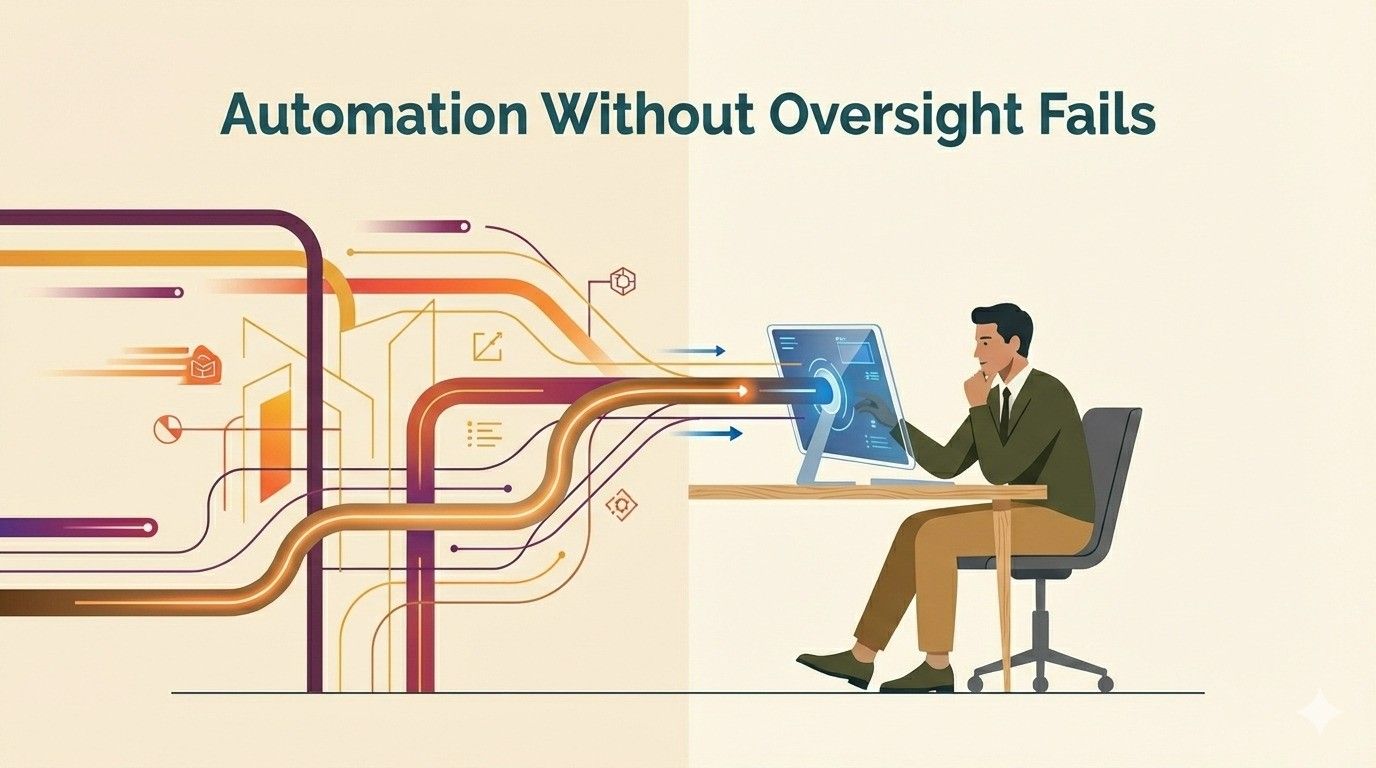
Automation gets blamed when people run out of explanations.
When numbers stop lining up.
When systems behave correctly but outcomes feel wrong.
When teams say, “We didn’t change anything.”
Automation becomes the easy answer.
But automation rarely breaks on its own.
It keeps doing exactly what it was told to do.
That is the uncomfortable truth.
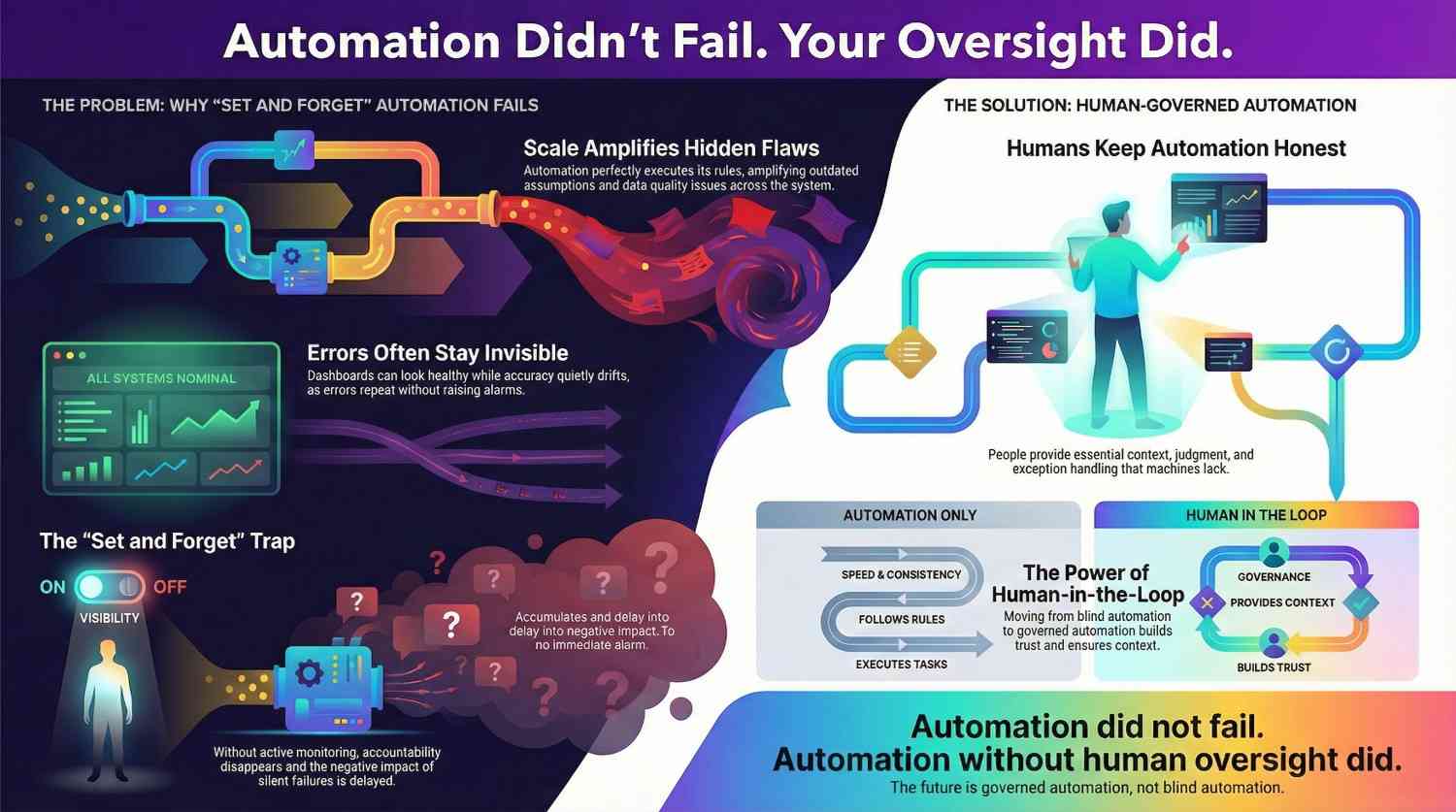
Automation fails at scale not because the technology stops working, but because it continues executing logic that no longer matches reality. As volume increases, small assumptions that once seemed harmless beg into create repeated errors that automation quietly amplifies.
Automation executes logic. It does not understand intent.
If the logic becomes outdated, automation does not complain.
If inputs change, automation does not pause.
If context shifts, automation does not ask questions.
It keeps running.
Automated systems are designed to execute rules consistently, not to evaluate whether outcomes still make sense. When assumptions change, and no human intervenes, automation continues operating even as results drift.
Most automation failures do not come from broken code. They come from assumptions that slowly stop being true.
An assumption about data quality.
An assumption about customer behavior.
An assumption about edge cases being rare.
Automation keeps executing the same rules against a reality that has shifted.
Automation errors are difficult to detect early because systems continue functioning normally on the surface. Dashboards show activity, not correctness, and small inaccuracies rarely trigger alerts until they have already scaled.
Automation is often sold as relief. Less monitoring. Fewer decisions.
In practice, it removes visibility faster than it removes work.
Responsibility does not disappear.
It becomes harder to see.
Human oversight provides contextual judgment that automation lacks. It allows teams to validate outcomes, identify exceptions, and intervene before small issues turn into systemic failures.
At low volume, mistakes are manageable.
At high volume, the same mistake becomes policy.
Automation repeats decisions, not just actions.
Automation did not fail as a technology. It failed as a strategy when it was treated as a replacement for accountability rather than a system that still requires governance and supervision.
The real mistake was never technical.
Automation was treated as autonomous rather than supervised. When responsibility becomes unclear, outcomes drift, and tools are blamed instead of processes.
They expect drift.
They design for intervention.
They monitor quality, not just throughput.
Automation runs fast.
Humans keep it honest.
Automation did not fail.
Automation without human oversight did.
The future is not less automation.
It is automation governed by human judgment.
Trust TRANSFORM Solutions to be your partner in operational transformation.
Book a free consutation
Get the latest news & updates from TRANSFORM Solutions directly into your inbox
Still wondering how TRANSFORM Solutions can help grow your business?
Book a Free Consultation


.png)