If you have searched what GCC is, the meaning of GCC, orwhat GCC stands for, you are not alone. The term GCC is increasingly used by multinational companies, consulting firms, and technology leaders. Yet it is often misunderstood.
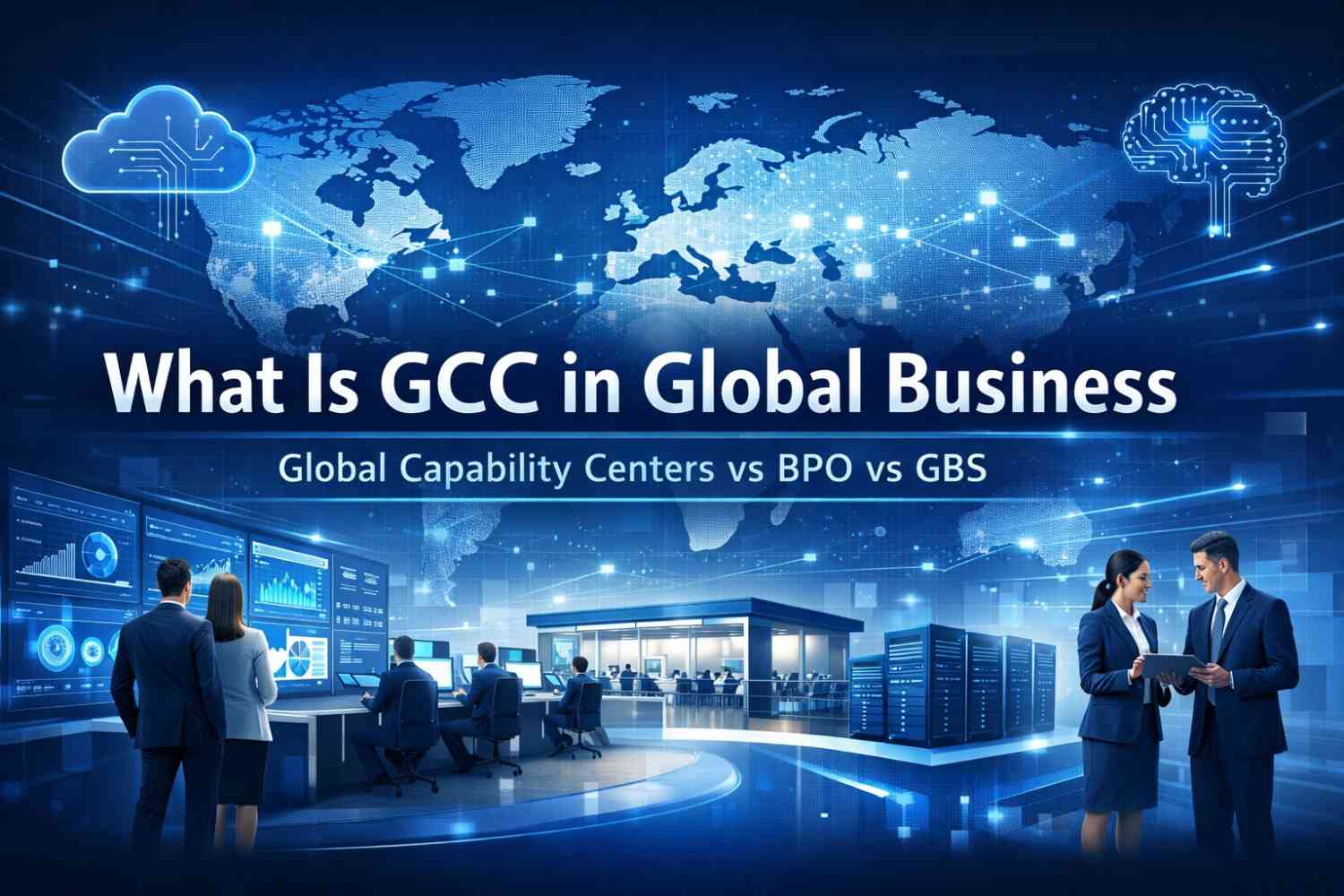
In business, GCC stands for Global Capability Center.
A Global Capability Center is a dedicated offshore or nearshore unit set up by a company to manage specific business functions, technology operations, analytics, finance, customer experience, or innovation initiatives. Unlike traditional outsourcing, a GCC is owned or strategically controlled by the parent organization.
To simplify:
• Business Process Outsourcing BPO means outsourcing work to a third party
• GCC means building your own controlled global operations hub
• Global Business Services GBS refers to an integrated model that combines shared services and centralized operations
Let us break this down clearly.

The gcc meaning in a corporate context refers to a strategic global operations center. It is not just about cost savings. Modern GCCs function as innovation hubs, technology accelerators, and revenue support engines.
A Global Capability Center typically supports:
• Finance and accounting
• Human resources
• Revenue operations
• Data analytics
• AI model training
• Business process outsourcing services
• Customer support
• IT infrastructure
In many multinational companies, the GCC acts as the backbone of global delivery.
When executives ask what GCC does, the answer depends on the maturity of the organization.
At a basic level, a GCC handles operational functions suchas payroll, procurement, compliance support, and reporting.
At an advanced level, GCCs manage:
• AI data annotation and model training
• Product engineering
• Cybersecurity operations
• Revenue DataOps
• Healthcare back office operations
• eCommerce catalog and marketplace management
Today, leading companies treat their GCC as a high value strategic unit, not a support function.
Many people confuse GCC with business process outsourcing BPO. They are related but not the same.
This model involves hiring an external service provider to manage certain processes. For example, business process outsourcing healthcare may include medical billing, claims processing, or patient data entry handled by a third party.
This model involves building a dedicated team that works exclusively for your company. Even if the center is offshore, it operates as an extension of your internal structure.
The key differences:
Ownership
BPO is vendor owned. GCC is company controlled.
Strategic alignment
BPO focuses on efficiency. GCC focuses on capability building.
Innovation
BPO handles processes. GCC builds innovation hubs.
For growth stage companies, this distinction matters significantly.
Another common query is what the definition of global business services is.
Global Business Services GBS is a centralized operating model that integrates shared services, outsourcing, and capability centers under one governance structure.
Think of it this way:
Shared services centralize similar functions like HR andfinance into one internal unit.
BPO outsources specific processes externally.
GCC builds dedicated global teams under your ownership.
GBS combines all three to create operational efficiency andstrategic control.
Leading multinational companies use GBS to streamline operations across regions while maintaining consistency and compliance.
Shared services and GCC are often mentioned together, but they are different concepts.
Shared services consolidate internal functions into acentralized unit. For example, one HR department serving all global branches.
A GCC may include shared services but also expands into advanced capabilities such as AI, product development, analytics, and digitaltransformation.
In modern enterprises, the GCC becomes the foundation of shared services and innovation.
Many people searching what is GCC country are referring tothe Gulf Cooperation Council, which includes Saudi Arabia, UAE, Qatar, Kuwait, Oman, and Bahrain.
However, in a business context, GCC usually means Global Capability Center.
The two meanings are unrelated. It is important to clarify this distinction in business discussions.
What are the top providers of global business services for multinational companies? Why are companies shifting toward GCC models?
The answer is simple. Control and scalability.
Multinational companies face challenges such as:
• Rising labor costs in the United States
• Talent shortages in AI and analytics
• Regulatory complexity
• Need for 24 hour global operations
A well structured GCC provides:
• 30 to 50 percent operational cost optimization
• Access to specialized talent pools
• Time zone leverage
• Stronger governance compared to traditional outsourcing
For healthcare, fintech, SaaS, and eCommerce companies, thismodel enables predictable scaling without compromising quality.
Which service providers specialize in establishing global capability centers?
The market includes consulting firms, managed operations partners, and technology driven BPO providers.
The top companies offering global capability center services typically provide:
• Location strategy and feasibility analysis
• Infrastructure setup
• Talent acquisition
• Compliance management
• Process transition
• AI enabled operational frameworks
For multinational enterprises, the right partner reduces execution risk and accelerates time to value.
However, not all providers are equal. Many focus only onlabor arbitrage. The next generation focuses on AI integration and human in the loop governance.
The term innovation hub is increasingly associated with GCCs.
Earlier, offshore centers handled repetitive tasks. Today,they:
• Train AI models
• Manage enterprise automation
• Support product launches
• Develop machine learning pipelines
• Power revenue intelligence
In technology companies, GCC teams contribute directly to product engineering and feature releases.
In healthcare, business process outsourcing healthcare models are evolving into hybrid GCC structures that support compliance, data analytics, and AI driven patient workflows.
In eCommerce, GCCs manage catalog intelligence, marketplace optimization, and revenue analytics.
This shift transforms GCC from cost center to growth engine.
Growth stage companies between 30 and 300 employees oftenreach a tipping point. Internal teams become overstretched. Operational complexity increases. Revenue execution slows.
At this stage, building a structured global capability center provides:
• Operational ownership without hiring dozens of US employees
• Dedicated teams aligned to revenue goals
• Long term scalability
• Improved EBITDA margins
Compared to pure business process outsourcing services, a GCC offers deeper integration and control.
Choose Business Process Outsourcing BPO when:
• The process is transactional and standardized
• Long term strategic ownership is not required
• Speed of implementation is critical
Choose GCC when:
• The function is revenue critical
• Data security and governance matter
• Innovation and AI integration are strategic priorities
• Long term operational ownership is required
For companies planning expansion into AI, analytics, healthcare support services, or eCommerce operations, GCC provides greater long term value.
If you searched what is GCC, gcc means, or what does GCC stand for, the answer goes beyond a simple definition.
A Global Capability Center is a strategic operating model that enables multinational companies to centralize shared services, integrate global business services, reduce costs, and build innovation hubs that power growth.
It differs from business process outsourcing BPO by offeringownership, integration, and strategic depth.
In a world where talent, compliance, and AI capabilities determine competitive advantage, the GCC model has become central to enterprise transformation.
For companies evaluating global scaling strategies, the real question is no longer what is GCC.
The real question is how soon your organization can build one that drives measurable ROI.
Trust TRANSFORM Solutions to be your partner in operational transformation.
Trust TransForm Solutions to be your partner in operational transformation.