The structure of enterprise operations has changed dramatically over the past decade. Organizations are no longer limited by geography when building teams, delivering services, or managing customers.
At the center of this transformation sits the Global Capability Center.
For multinational companies, a Global Capability Center is not just an offshore office. It is a strategic unit that enables global operations, digital operations, and scalable data operations while supporting long term cost efficiency.
To understand its impact, we need to connect it withbusiness process outsourcing, shared services, and global business services.
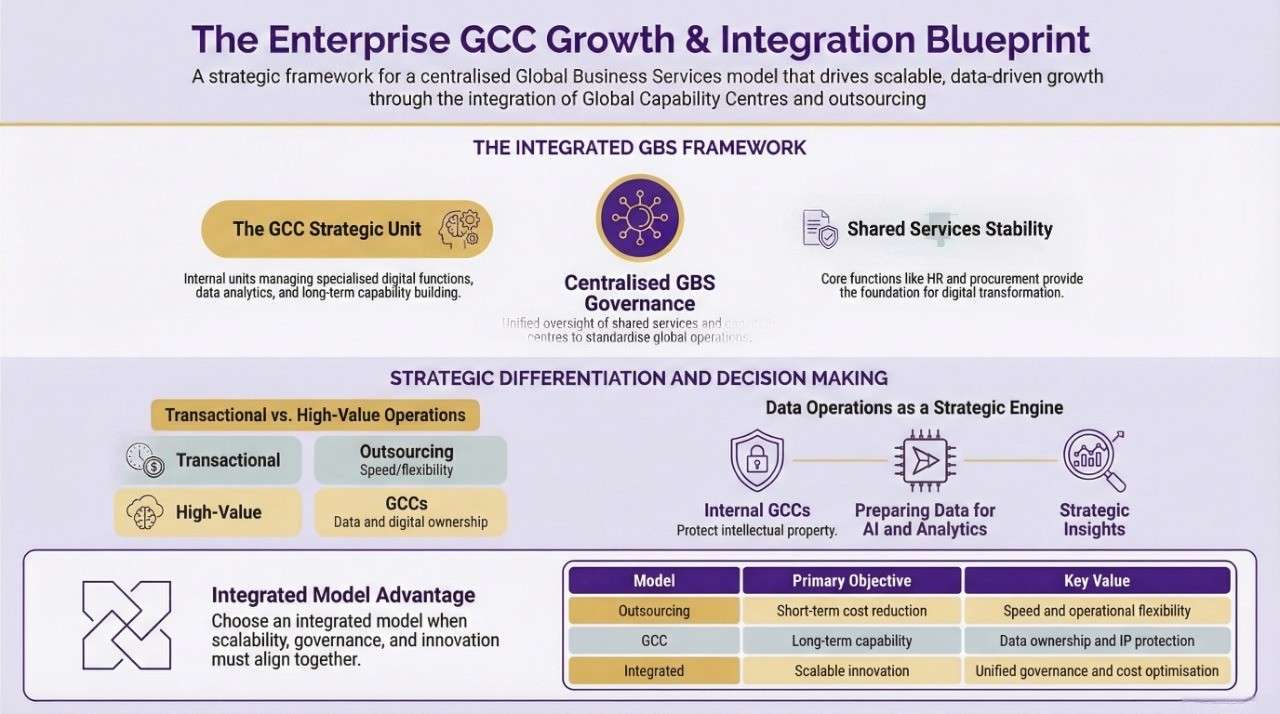
A Global Capability Center is a dedicated operational unit established in another region to manage specialized functions for the parent organization.
Unlike traditional business process outsourcing, where workis transferred to a third-party vendor, a Global Capability Center operates as an extension of the enterprise. It aligns with company goals, compliance standards, and long-term innovation strategies.
These centers commonly manage:
• Digital operations
• Remote operations support
• Data operations and analytics
• IT development and infrastructure
• Finance and shared services
• Customer experience support
The shift from transactional outsourcing to capability building is what differentiates modern global operations models.
The definition of global business services refers to an integrated framework that centralizes shared services, outsourcing partnerships, and capability centers under unified governance.
Global business services aim to:
• Standardize enterprise operations
• Eliminate duplication across departments
• Improve cost optimization
• Increase visibility across regions
• Strengthen data-driven decision-making
In large multinational companies, global business services function as the operational backbone connecting global workforce management, compliance, and digital transformation initiatives.
Enterprises often ask about the benefits of implementing aGBS model.
A structured GBS framework delivers measurable advantages:
Operational efficiency
Centralized oversight reduces fragmented workflows and inconsistent reporting.
Cost optimization
Shared infrastructure and workforce pooling reduce overhead.
Scalability
Companies can expand into new markets without replicating internal departments in each region.
Improved compliance
Governance becomes standardized across geographies.
Enhanced digital operations
Technology platforms are integrated across finance, HR, procurement, and customer systems.
For organizations seeking sustainable growth, GBS reduces structural complexity while strengthening accountability.
Business process outsourcing remains a vital component of global expansion strategies.
Benefits of outsourcing non-core business activities include:
• Freeing internal leadership to focus on strategic initiatives
• Accessing specialized expertise
• Reducing fixed labor costs
• Accelerating implementation timelines
Which business process outsourcing providers specialize in IT support services?
Leading providers focus on infrastructure management, cloud support, cybersecurity monitoring, and enterprise application management.
However, enterprises increasingly combine business process outsourcing with a Global Capability Center approach. High-value data operations and digital transformation initiatives are often retained within the GCC model, while standardized transactional tasks are outsourced.
This hybrid structure supports both flexibility and control.
A global workforce is no longer optional for growth-stage or multinational companies.
Remote operations and distributed teams enable organizations to tap into global talent markets for engineering, analytics, compliance, and customer experience roles.
Through a Global Capability Center, companies gain:
• Access to skilled data operations analysts
• Dedicated software engineering teams
• Round-the-clock digital operations coverage
• Local compliance expertise in foreign markets
This model creates an integrated global operations structure that remains aligned with headquarters strategy.
Modern enterprises generate massive volumes of data. Without structured data operations, this information becomes noise rather than insight.
Data operations within a Global Capability Center typically include:
• Data cleansing and enrichment
• Data pipeline management
• Business intelligence reporting
• AI training data preparation
• Compliance monitoring
The role of a data operations analyst has evolved beyond reporting dashboards. Today, these professionals support predictive modeling, revenue intelligence, and operational optimization.
By housing data operations inside a GCC, organizations protect intellectual property while building long-term analytics capabilities.
How do you compare pricing for popular business process outsourcing solutions?
Enterprises should evaluate pricing models based on:
• Fixed cost contracts
• Dedicated team structures
• Performance-based pricing
• Hybrid engagement models
Cost comparison must include not only labor rates but also onboarding speed, quality assurance processes, attrition risk, and governance standards.
Low headline pricing can conceal hidden transition costs orproductivity gaps.
The most effective approach measures the total cost of ownership across the life cycle of the engagement.
As organizations expand global operations, compliance becomes increasingly complex.
How to find a reliable employer of record service?
An employer of record enables companies to hire employees inforeign countries without establishing a legal entity.
Key factors to evaluate include:
• Regulatory expertise
• Tax compliance capabilities
• Transparent fee structures
• Payroll integration systems
What companies offer global payroll solutions for multinational teams?
Leading payroll platforms provide centralized dashboards that manage compensation, benefits, and statutory compliance across jurisdictions.
Integrating payroll solutions within a broader global business services model enhances visibility and reduces administrative risk.
Shared services remain central to operational stability.
A shared services framework consolidates repetitive administrative functions such as accounting, HR support, and procurement.
When integrated with a Global Capability Center, shared services expand beyond cost efficiency. They become data-driven and digitally enabled.
Cloud platforms, workflow automation tools, and performance dashboards allow enterprises to monitor global operations in real time.
This digital infrastructure supports both remote operations and cross-regional collaboration.
Organizations must evaluate their strategic objectives before choosing between business process outsourcing, shared services, or a Global Capability Center.
If the objective is short-term cost reduction, outsourcing may suffice.
If the objective is long-term digital operations transformation, building a Global Capability Center aligned with global business services offers stronger strategic control.
For high-growth companies, combining these models creates abalanced structure.
Transactional processes may be outsourced.
Strategic data operations remain within a GCC.
Shared services ensure internal standardization.
This layered model supports resilience and scalability.
The real advantage does not lie in choosing one structure over another.
It lies in integration.
A mature global operations framework aligns business process outsourcing, shared services, and Global Capability Centers under unified governance.
This integration delivers:
• Transparent cost optimization
• Enhanced compliance management
• Stronger digital operations capability
• Scalable global workforce deployment
• Data-driven decision support
For multinational companies navigating complex expansion environments, this operating model creates sustainable competitive advantage.
The Global Capability Center has evolved into a centralpillar of enterprise strategy.
When integrated with global business services, shared services, and selective business process outsourcing, it enables organizations to scale responsibly while maintaining control.
The future of enterprise growth depends on building digital operations, strengthening data operations, and managing a global workforce effectively.
Companies that align these elements within a cohesive global operations strategy move beyond simple cost reduction.
They build operational engines that power innovation, compliance, and long-term value creation.
Trust TRANSFORM Solutions to be your partner in operational transformation.
Trust TransForm Solutions to be your partner in operational transformation.