
The freelance economy grew rapidly during 2022–2024 as companies tried to cut costs, stay flexible, and experiment with offshore talent. For small, isolated tasks, freelancers still work well.
But in 2025, something changed.
As AI workflows scaled, as accuracy became a top priority, and as operations grew more complex, companies discovered that fragmented talent models created new problems
This is why 2026 is shaping up to be the year of Dedicated Hybrid Teams, a full-time, specialized, SLA-driven operations partner model designed for accuracy, speed, and predictability.
In this article, we compare both models honestly, with real operational examples from accounts where accuracy and workflow stability matter more than cost-per-hour.
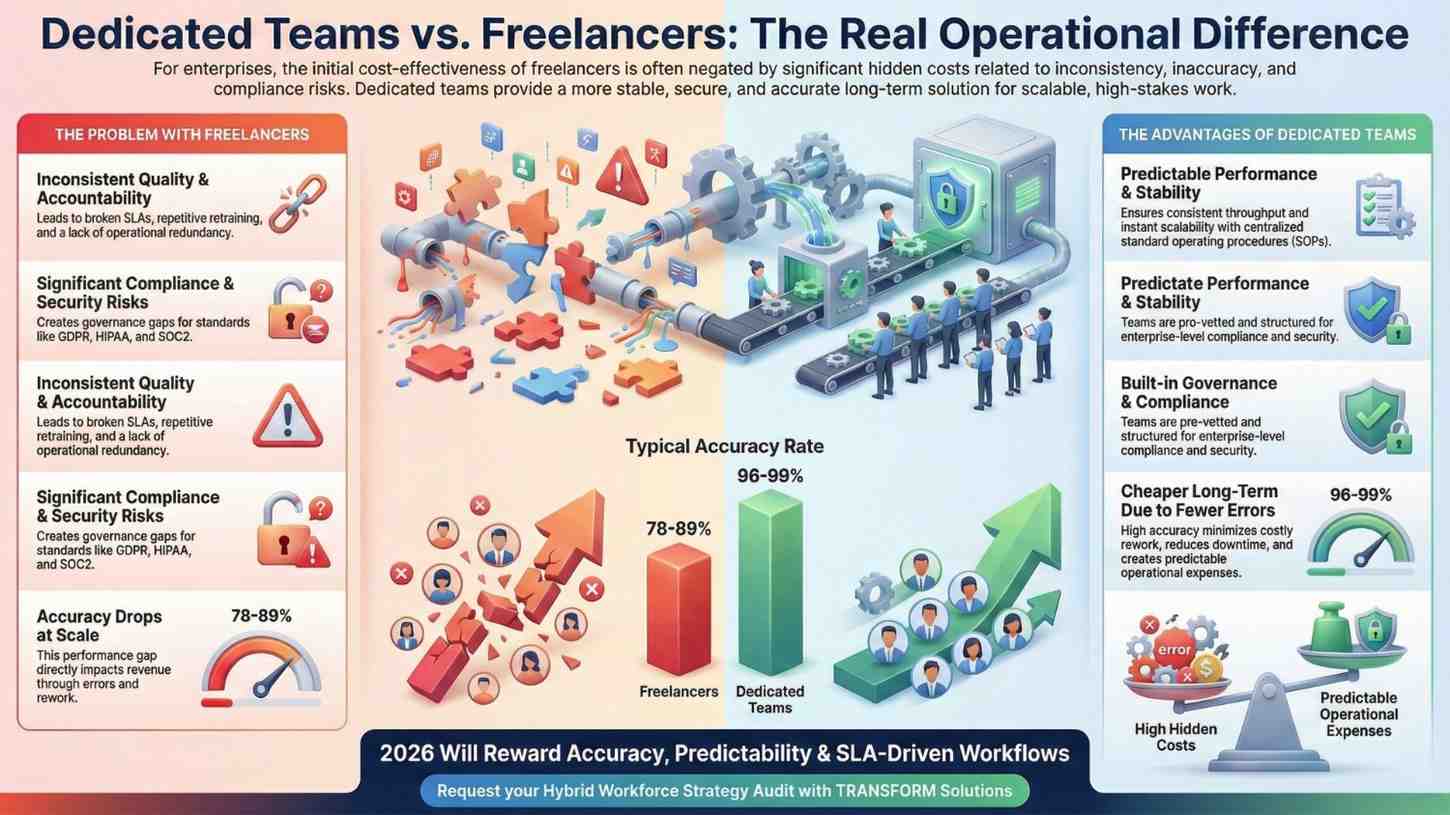
Dedicated Teams significantly outperform freelancers in workflows requiring:
Let’s break down the real-world differences.
Freelancers perform well on single tasks.
They struggle with repeated accuracy across high-volume workflows.
Real scenario:
A retailer hired 6 freelancers to manage product attributes during a seasonal spike. Inconsistent taxonomy understanding led to:
These errors reduced search ranking and cost the brand direct revenue.
Dedicated Teams, by contrast:
Accuracy gap observed in 2025:
Freelancers: 78–89%
Dedicated Teams: 96–99%
This difference directly affects revenue and operational stability.
Freelancers complete tasks.
Dedicated Teams own the workflow.
This includes:
Example:
A marketplace onboarding project required 20–30 decisions per SKU.
Freelancers treated each SKU as an isolated task → inconsistency.
Dedicated Teams treated it as a structured pipeline → stability.
This difference matters when your workflows involve:
These require ownership, not isolated task completion.
Scaling freelancers beyond 5–10 people creates unpredictability:
In contrast, Dedicated Teams provide:
One FinTech client scaled from 8 → 58 analysts in 7 days.
This level of scale is impossible with a freelancer pool.
Most freelancers do NOT operate under:
This becomes a major risk for:
Dedicated Teams include:
This makes them suitable for regulated industries; freelancers are not.
Freelancers cannot commit to enterprise-grade SLAs such as:
Dedicated Teams are built around these commitments.
Example:
A marketplace client required catalog updates every 60 minutes during peak hours.
Freelancers could not guarantee uptime.
A hybrid team delivered updates every 15 minutes with audit logs.
Freelancers leave abruptly.
Dedicated Teams provide:
This is critical for workflows where historical context matters.
Freelancers appear cheaper until accuracy declines or rework accumulates.
Companies often ignore:
Dedicated Teams reduce hidden OPEX by delivering:
The true cost comparison flips:
Cheap freelancers → expensive errors
Dedicated teams → stable output and predictable OPEX
Use this decision guide:
Choose freelancers if:
Choose Dedicated Teams if:
In most enterprise cases, Dedicated Teams provide strategic stability that freelancers cannot.
Freelancers offer flexibility.
Dedicated Teams offer control.
And in 2026, when AI workflows rely on human correction, validation, and governance, control is far more valuable than flexibility.
Hybrid, dedicated pods are becoming a strategic asset, not just a staffing choice.
To evaluate which model your operations need, request a:
2026 Hybrid Workforce Strategy Audit with TRANSFORM Solutions.
Trust TRANSFORM Solutions to be your partner in operational transformation.
Trust TransForm Solutions to be your partner in operational transformation.