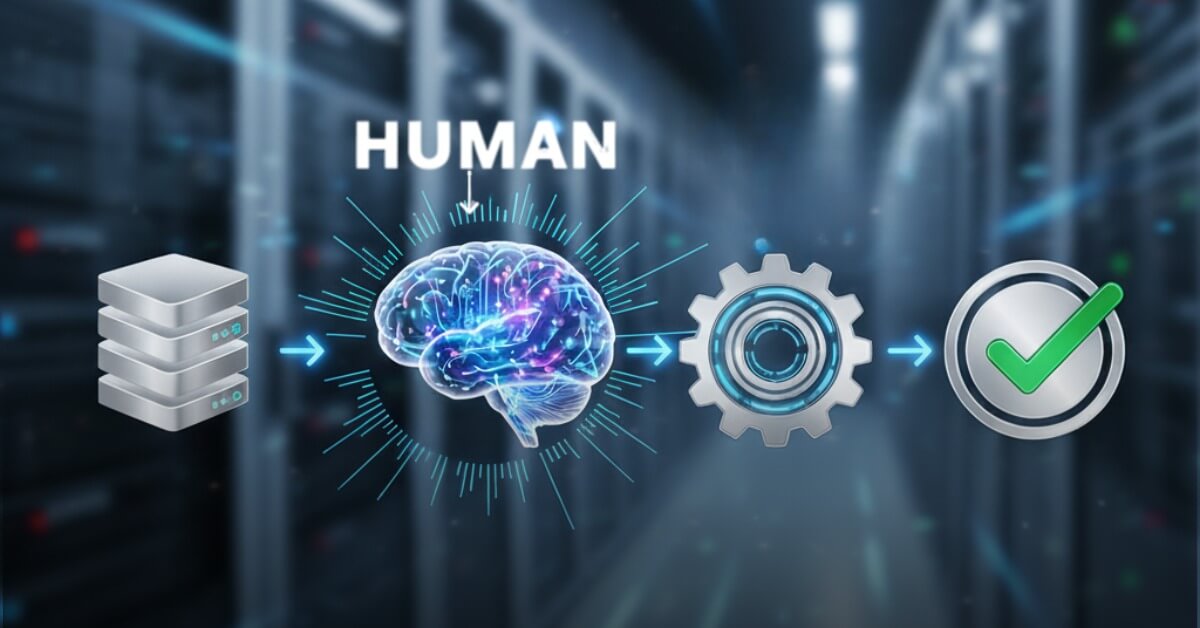
Automation was supposed to simplify things. So why are teams working faster but understanding less?
Welcome to the age of intelligent automation, where processes run with excellent algorithmic accuracy, dashboards are loaded with data, and machines complete jobs at lightning speed. It appears to be the ideal route to achieving operational excellence on the surface. Beneath that efficiency, however, lies an underappreciated weakness: organizations lose the context necessary to direct, challenge, and improve their systems when automation develops more quickly than human cognition. They consequently fall into what is known as the efficiency trap, which causes them to work more rapidly but comprehend less with each automated step.
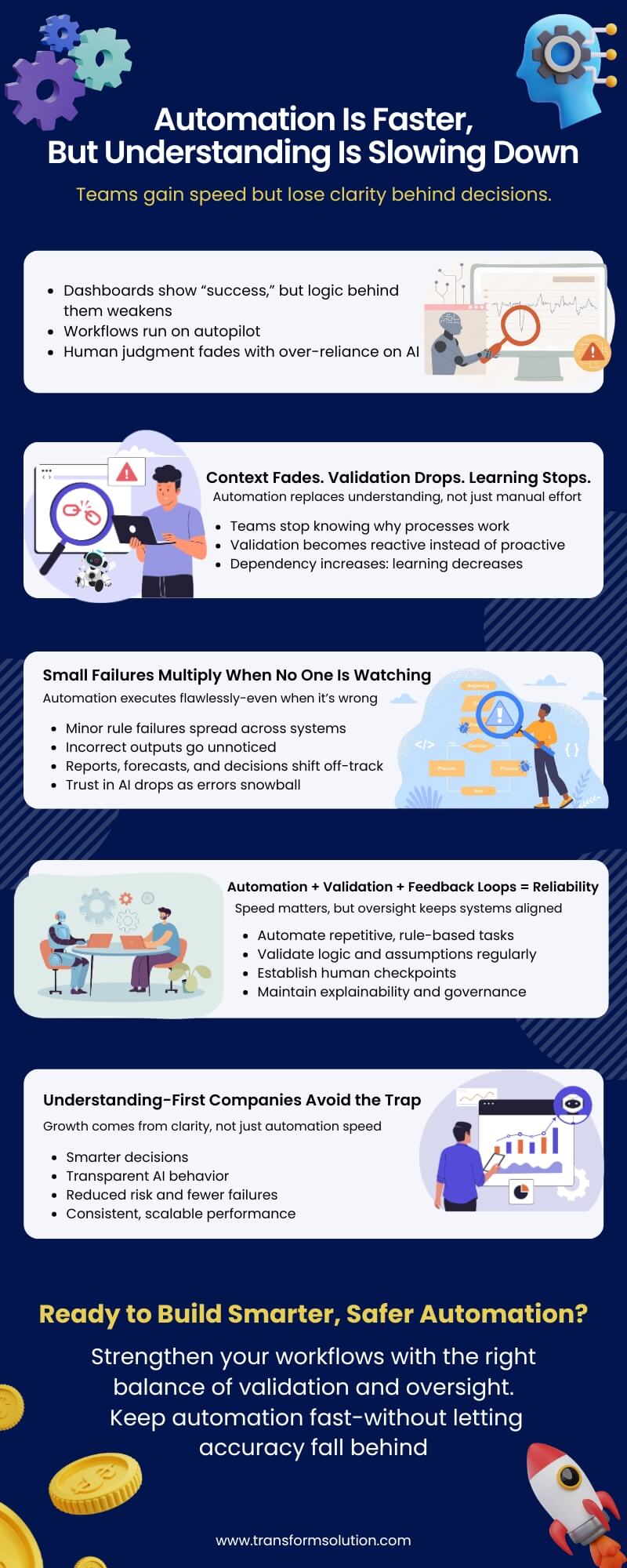
Speed is promised by automation, artificial intelligence, and intelligent process automation, and they undoubtedly deliver. However, many firms overlook a fundamental fact in their push for operational efficiency: comprehension and speed are not synonymous. Faster workflows may appear great on dashboards, but they can become insecure systems that run on autopilot without human understanding, validation, and insight.
One unexpected consequence of firms using automated intelligence to speed activities is that the more profound logic underlying the process starts to fade.
Workers eventually cease understanding why a process works the way it does when workflows are entirely automated. Teams' ability to troubleshoot, question, and improve operations is gradually diminished. Instead of being assessors who comprehend the button's mechanism, they turn into operators who press buttons.
Teams gradually come to believe that the system knows best since automation consistently handles repetitive decisions. Process validation, which was initially a proactive precaution, eventually turns into are active operation that is only carried out when something goes wrong. Minor grammatical errors or changes in real-world circumstances often go unnoticed in the absence of constant examination.
Reliance on automatic intelligence increases as comprehension decreases. Workers no longer acquire the knowledge necessary to question or modify the system. The organization becomes reliant on automation, which it no longer fully understands, as human judgment becomes increasingly unreliable.
In many cases, the human knowledge ecology that surrounds automation subtly deteriorates rather than the technology itself. Businesses unintentionally develop systems that are automated but more out of step with the complexity of the actual world, speedier but flakier, and efficient but unclear. Strong validation frameworks, AI ethics, and governance become crucial in this situation.
Without them, companies fall into quack AI governance, which is a deceptive appearance of control that conceals a total lack of actual oversight. Even the tiniest mistakes start to compound at scale once a system reaches that point, transforming modest gaps into significant operational failures.
Over-automation creates a misleading comfort - teams eventually stop challenging a workflow's choices, reasoning, or results when it runs smoothly for a sufficient amount of time. The appearance of dependability is produced by familiarity. Organizational risk reaches its peak at this precise period. Little irregularities can develop into significant operational failures when there is no oversight.
Suppose a business process automation pipeline that can route recommendations, validate access, consume consumer data, and start downstream actions. The system is blindly trusted as long as it seems to function flawlessly. However, the pipeline continues to function—just improperly—if even one rule, validation filter, or mapping parameter silently malfunctions.
These mistakes often go unreported until they result in quantifiable harm, because automation is designed to execute, not to explain. Errors start to occur when there is no active monitoring or comprehension of the reasons behind the system's behavior.
● Multiply throughout the process.
● Spread throughout departments
● Connect with outside clients and partners.
● Misrepresent forecasts and reports.
● Sabotage confidence in artificial intelligence.
When companies depend on technologies such as intelligent automation, artificial intelligence, predictive analytics, AI-driven decision-making, and thoughtful process automation, this situation becomes precarious. These techniques are derived from data, and if the verification loop is insufficient, they may also pick up incorrect methods, support incorrect information, or support wrong ideas. Automation efficiency becomes a myth when this occurs.
Dashboards and performance indicators give the impression that the company is optimized, but underlying procedures are subtly deviating from reality. Automation adds layers of complexity that teams are no longer able to solve, rather than bringing clarity. Speed alone is not enough for proper business process optimization.
It necessitates ongoing dedication to rules, human review, moral concerns, and corporate objectives. As a result, companies that rush toward automation without robust AI governance often find themselves in difficult circumstances. Although they attain speed, they fall short of operational perfection.
It's essential to define operational excellence before exploring how companies can fall into the efficiency trap. Process automation and operational excellence are often confused. Operational excellence is actually a comprehensive field.
The constant pursuit of enhanced performance, flexibility, and value generation via well-thought-out procedures, empowered personnel, and quick decision-making is known as operational excellence.
It has nothing to do with working more quickly. It involves working more intelligently, precisely, and strategically every day.
● Businesses that define operational excellence correctly recognize that automation is a tool, not a destination.
● Technology, procedures, and people must all change simultaneously.
● Feedback loops and validation are just as important as speed.
Without these guidelines, automation loses touch with reality and companies unintentionally adopt large-scale inefficiencies.
Every company is under pressure to grow. Leaders desire leaner operations, quicker workflows, and fewer mistakes. Automation is the ideal solution, but context and timing are essential.
This is the point at which excessive or early automation backfires.
Automation fixes process weaknesses, including inconsistent procedures, ambiguous regulations, or changing parameters.
The automated process becomes a black box, concealing flaws that should have been addressed first when teams overlook the crucial step of verifying assumptions.
Without supervision, systems start making decisions. Ultimately, no one is aware of how or why the system made a specific decision.
Both strengths and shortcomings are amplified by speed. Automation speeds up failure if the underlying logic is faulty.
The system cannot make course corrections without human checkpoints and contextual evaluation. For this reason, established businesses use a hybrid strategy that combines automation with human intelligence, process validation, and ongoing monitoring. This equilibrium avoids the efficiency trap.
According to TRANSFORM Solution, automation is never sufficient to achieve operational excellence. Harmony between human skill and technology is necessary for truly excellent operations. Three pillars form the foundation of this philosophy.
Automate high-volume, repetitive, rule-based processes to increase productivity and lower human error.
Ensure that each automated system is regularly evaluated for correctness.
● Applicability
● Uniformity
● conformity to corporate objectives
● adherence to AI governance and ethics
Process validation is the cornerstone of automation reliability; it is not optional.
Every automated procedure needs to provide human teams with insights so they can:
● Analyze the performance
● Recognize the underlying causes
● Refine the regulations
● Verify the results
● When strategy changes, reroute the automation.
A self-correcting environment is produced by this combination, where automation enhances performance without sacrificing comprehension.
Businesses that use this strategy report greater results:
● AI functionality
● efficiency of automation
● Optimization of business processes
● Clarity of governance
● Sustained operational excellence
Let's examine areal-life situation that was modified from a typical business problem to illustrate the efficiency trap in action.
A mid-sized business chooses to utilize intelligent process automation and artificial intelligence to automate its client onboarding process.
Cut the 72-hour onboarding process down to 8hours. Leadership is pushing for quick implementation because, on paper, the automation functions perfectly in a controlled setting.
There was insufficient validation of the business rules.
The requirements for onboarding were interpreted differently by various departments.
Contextual exclusions were disregarded.
For VIP clients, sales personnel frequently handled edge cases by hand; automation did not account for this.
The quality of the data varied greatly.
Inconsistencies, out-of-date classifications, and incomplete fields were among the historical data used for AI training.
There was no structure for AI governance.
The system was only required to make its decisions; it was not obligated to explain them.
As the automation was taught on faulty criteria, it started rejecting valid applications at scale. The technology was unable to distinguish between typical changes and actual irregularities.
● Onboarding new customers decreased by 18%.
● The number of support tickets streamed.
● Cases that were mistakenly reported were manually reprocessed by sales teams.
● Stakeholder confidence fell.
● Rather than being a solution, the automation turned into a backup.
Most significantly, due to the complete automation of the process, nobody could recall how to fix it. The organization's knowledge had diminished.
In the end, the business had to:
● Rebuild the process
● Retrain the models
● Restore the layers of manual approval.
● Carryout comprehensive process validation.
● Restore a framework for governance
The mismatched understanding was the issue, not the automation. This is an example of the efficiency trap in action when automation surpasses comprehension; businesses eventually have to pay the price, plus interest.
A change in perspective from automation-first to understanding-first is necessary to break free from the efficiency trap. The following are the primary tactics used by progressive businesses.
Process validation verifies that a workflow's logic is correct, comprehensive, and consistent with actual business operations.
Every automated decision is transparent, explainable, and responsible, thanks to AI governance.
Systems are kept from deviating from your strategic goals by human monitoring.
Automation changes over time can be seen through analytics, audits, and exception monitoring.
Instead of eliminating human skill, automation should enhance it.
Systems must change as the business does.
By following these guidelines, automation can become a source of operational excellence rather than a cause of hidden risk.
The speed at which your workflows move is not a measure of operational excellence. It is determined by how well your teams comprehend the reasoning behind your operations, how precisely your systems operate, and how brilliantly your processes adapt. Only when combined with introspection, validation, and ongoing learning can automation be a potent accelerator.
When businesses strike a balance:
● Speed of automation
● Human comprehension
● Validation and governance
● Adaptability and feedback loops
They break free from the efficiency trap and advance toward strategic excellence and long-term stability.
Trust TRANSFORM Solutions to be your partner in operational transformation.
Trust TransForm Solutions to be your partner in operational transformation.