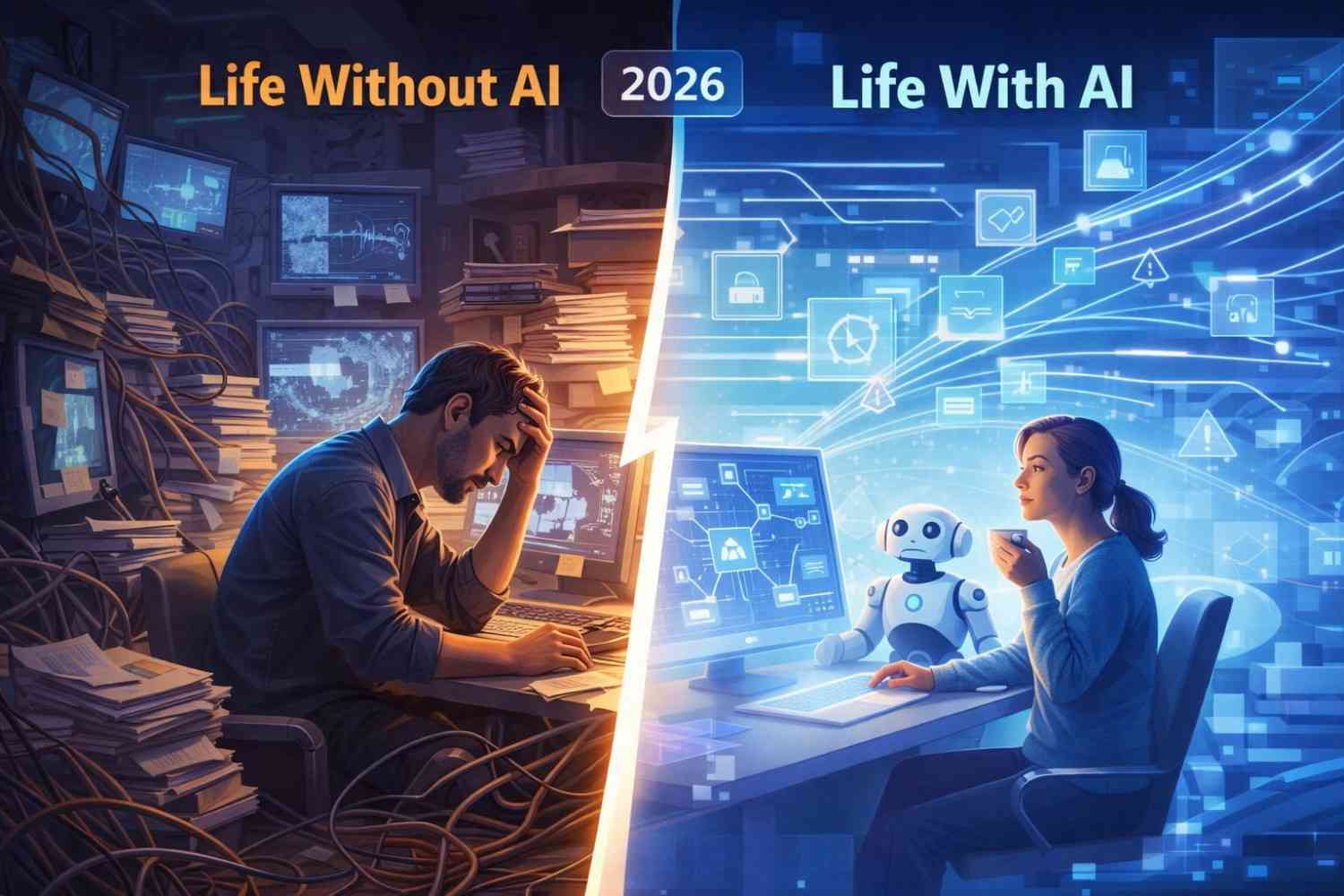
By 2026, AI will no longer be something leadership teams are deciding to adopt. It is something they are already living with.
Even organizations that believe they are “moving cautiously” are affected. Customers expect faster responses. Data volumes exceed human capacity. Competitors make decisions in days that once took quarters. AI has become part of the operating environment, not a strategic option.
What has changed most is not technology. It is a responsibility.
Automation has altered where decisions happen, how quickly outcomes appear, and how difficult it can be to explain why something went wrong. From the executive seat, this shift feels subtle at first. Then it becomes unavoidable.
The difference between companies that are gaining leverage from AI and those accumulating risk is no longer adoption. It is ownership.
.jpeg)
Life with AI in 2026 feels faster than most leadership teams expected.
Revenue signals surface earlier. Customer behavior becomes easier to observe. Execution moves with less friction. When AI is designed thoughtfully, leadership gains time back, not just efficiency.
In these environments, AI supports judgment. It does not replace it.
Executives can see problems forming before they become visible to customers or boards. Decisions still require human intent, but they are informed by systems that process far more information than teams ever could manually.
However, this experience only exists when AI operates within clear boundaries.
Where those boundaries are missing, life with AI feels very different. Outcomes appear quickly, but explanations arrive slowly. Teams rely on dashboards without understanding the assumptions underneath them. When something breaks, no one is certain where responsibility truly lies.
Automation works. Oversight is what fails.
In 2026, AI does not reduce leadership burden. It changes its shape. Responsibility becomes more concentrated, not more distributed.
Life without AI is often described as safer. In reality, it is heavier.
Organizations that rely primarily on manual processes struggle to keep pace with the volume and speed of modern operations. Teams work harder to maintain the output that competitors achieve with fewer people and better systems.
From a leadership perspective, this can feel reassuring at first. Decisions are familiar. Accountability is visible. There are fewer black boxes.
But the cost shows up slowly.
Customer insights arrive too late to influence outcomes. Revenue opportunities pass unnoticed. Headcount grows just to keep up, not to get ahead. Over time, effort increases while leverage declines.
Without AI, risk does not disappear. It accumulates quietly as inefficiency, fatigue, and missed timing.
Leadership retains control, but loses momentum.
The real decision in 2026 is not between using AI and avoiding it.
It is between governed automation and unmanaged automation.
AI changes how accountability functions inside an organization. When systems execute decisions, leadership still owns the result, regardless of whether a human approved each step.
Organizations that scale responsibly accept this early. They automate execution while preserving human judgment at points where errors are costly, irreversible, or trust-damaging.
This is why Human in the Loop operating models are becoming foundational rather than optional.
Not because AI is unreliable, but because it is powerful enough to fail quietly.
Boards and investors have become far less interested in whether AI exists inside an organization. They are far more interested in how it is governed.
They look for clarity around decision ownership.
They ask how errors are detected.
They assess whether accountability is visible before problems surface externally.
Organizations with disciplined AI oversight inspire confidence. Leadership can explain outcomes, correct mistakes quickly, and demonstrate control even as automation scales.
Organizations with unchecked automation raise concerns. Risk appears unpredictable. Responsibility feels diffused. Problems surface late.
Companies operating without AI face a different challenge. Their risks unfold more slowly, but just as surely, through rising costs and limited scalability.
In both North America and Europe, AI is now evaluated as a signal of operational maturity, not technical ambition.
Across resilient organizations, similar patterns appear.
Where AI affects customers, revenue, or compliance, human validation is deliberately retained.
Where data volume overwhelms internal teams, operational ownership is structured rather than improvised.
Where automation introduces blind spots, oversight is added instead of removed.
This is not about chasing tools or trends. It is about designing systems that can recover when something goes wrong.
AI performs best when leadership assumes it will drift over time and plans for correction rather than perfection.
AI in 2026 is not about intelligence. It is about discipline.
Life with AI works when leadership treats automation as an extension of responsibility, not a shortcut around it.
Life without AI works only temporarily, and at growing cost.
The organizations that endure will not be defined by how quickly they adopted AI, but by how clearly they decided where accountability lives.
Automation does not replace leadership.
It exposes it.
Trust TRANSFORM Solutions to be your partner in operational transformation.
Book a free consutation
Get the latest news & updates from TRANSFORM Solutions directly into your inbox
Still wondering how TRANSFORM Solutions can help grow your business?
Book a Free Consultation


.png)