
Back

How to Make AI GDPR-Safe in 2026 Using Human in the Loop Controls

Published on:
December 11, 2025
By:
TRANSFORM's

Over the past 18 months, companies across FinTech, Insurance, Healthcare, and SaaS have moved aggressively toward automated decisioning, document extraction, fraud detection, KYC, claims processing, and customer identity workflows.

But AI adoption has quietly created a new risk most leaders didn’t expect:

AI models can violate GDPR even when the company believes the workflow is compliant.

The problem is rarely intentional misuse.

It is almost always a misinterpretation of documents, fields, image metadata, timestamps, or PII categories.


As regulators sharpen their stance in 2025–2026 (AI Act, GDPR tightening, financial-sector scrutiny), compliance failures now happen at a technical level, not a policy level.


This is where the Human-in-the-Loop (HITL) compliance layer becomes essential.
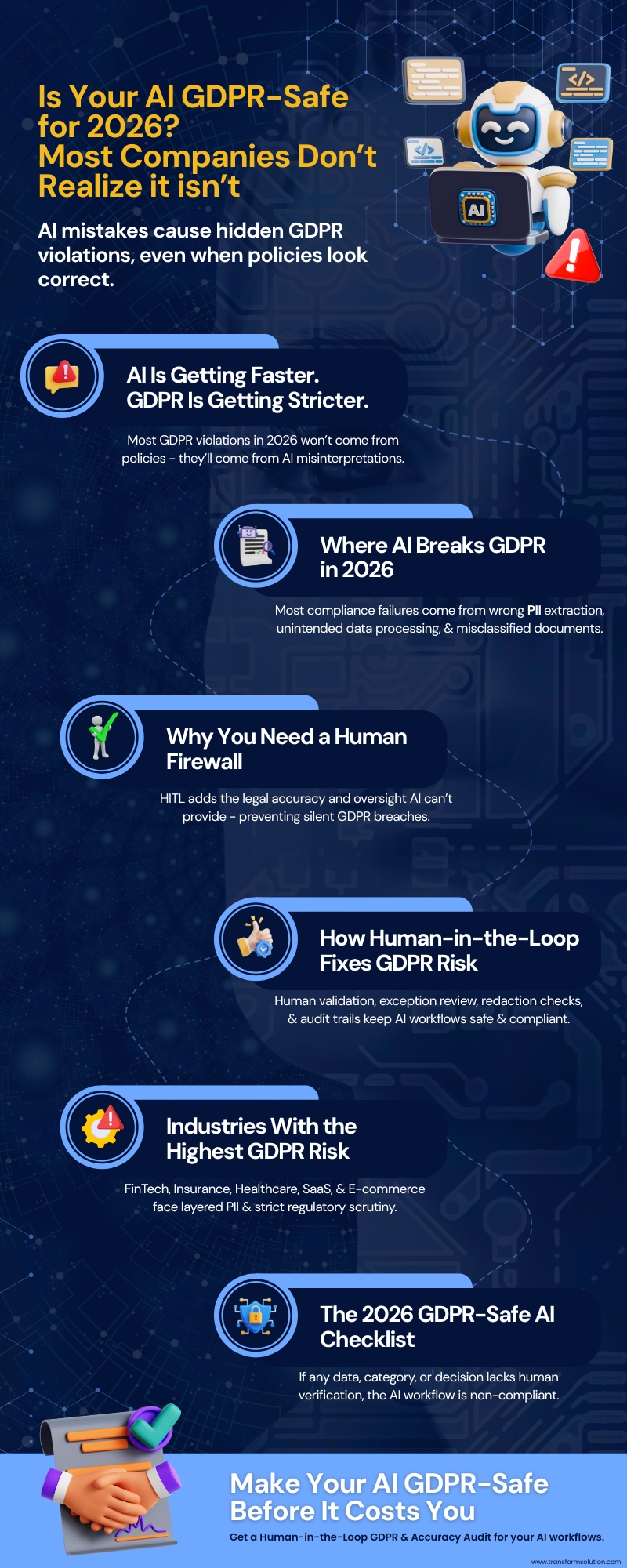
AI GDPR infographic explaining hidden compliance risks, where AI misinterprets data, why human verification is needed, and how HITL keeps workflows safe.


What Makes AI Workflows Non-Compliant With GDPR?

The most common causes of GDPR violations in AI systems come from technical inaccuracies, not policy negligence.

Here is where AI breaks:

1. Incorrect Extraction of PII (The Most Common Violation)

AI models misread:

  • dates
  • addresses
  • nationality
  • ID numbers
  • names with accents
  • multi-page identity documents


Real example:

A European insurer’s AI repeatedly misread “01/08/1991” as“08/01/1991,” swapping day/month formats.

This led to:

  • incorrect age categorization
  • Wrong policy mapping
  • unsafe data processing
  • GDPR-relevant misclassification
  • Not malicious, but definitely non-compliant.


2. Processing Categories the User Never Consented To

Under GDPR, you must process ONLY the data types the user explicitly agreed to.

AI often extracts:

  • background text
  • signatures
  • visible objects
  • embedded metadata
  • GPS coordinates from images

This becomes unintended data processing, a GDPR breach.


3. Missing or Incorrect Legal Basis Assignment

The AI maps fields incorrectly → the system assumes the wrong legal basis.

Example:

  • A “residence document” is misclassified as “proof of income.”
  • A driver’s license is categorized as “work authorization.”
  • Wrong lawful basis = non-compliance.

4. Inaccurate Document Classification

GDPR requires precise categorization of:

  • financial documents
  • identity documents
  • health records
  • minors’ documents

AI misclassifies documents when formats vary or images are low quality.


5. Unvalidated Decisions in Automated Workflows

Articles 22, 35, 47 require human oversight when:

  • Decisions affect rights
  • financial consequences occur
  • eligibility is determined
  • Companies mistakenly assume AI can make final decisions.

It cannot unless a human verification layer exists.


Why AI Needs a Human Firewall in 2026

A Human Firewall ensures that no sensitive data is processed, stored, or categorized incorrectly before a decision is made.

It prevents:

  • incorrect PII extraction
  • risky automated decisions
  • document misclassification
  • inaccurate risk scoring
  • downstream compliance violations
  • regulatory penalties

HITL = AI handles volume → humans ensure legality and accuracy.


How Does HITL Reduce GDPR Risk in AI Workflows? (AEO Question)

Below are the four critical protection layers:

1. Human Validation Before AI Outputs Enter the System

HITL teams verify:

  • PII accuracy
  • category mapping
  • identity extraction
  • multi-page alignment

This step prevents bad data from entering the system.

Example:

In KYC workflows, HITL validation reduced false PII capture by 42% for a UK FinServ client.


2. Exception Handling for High-Risk Cases

AI confidence scores drop with:

  • handwritten documents
  • older ID formats
  • non-standard templates
  • low-resolution images
  • These become GDPR landmines.

HITL exception triage prevents incorrect automated decisions.


3. Sensitive Data Redaction & Consent Verification

HITL ensures:

  • only allowed fields are processed
  • minors’ data is flagged
  • sensitive data categories match consent
  • biometric data is handled under strict rules

This preserves the legal basis for processing.


4. Compliance Documentation & Audit Trails

HITL creates:

  • human-reviewed logs
  • validated decision trails
  • cross-checked data entries
  • documented overrides

These protect the company during regulatory audits.


Industry Use Cases: Where GDPR Risk Is Most Severe

Insurance & FinTech (insert link)

  • claims documents with multiple PII categories
  • handwritten accident notes
  • inconsistent financial statements
  • identity verification mismatches

Healthcare

  • lab reports with mixed health + identity data
  • prescriptions with embedded sensitive data
  • insurance forms containing minors’ PII

SaaS Platforms

  • log files containing hidden PII
  • analytics tools capturing unauthorized fields
  • CRM syncs violate data minimization

E-commerce

  • KYC for returns
  • multi-actor documentation during chargebacks

HITL adds discipline where automation adds ambiguity.


What AI Outputs Require Mandatory Human Review Under GDPR?

Your content writer should emphasize:

You must use HITL for:

  • eligibility decisions
  • claims/loan approvals
  • identity verification
  • document classification
  • risk scoring
  • fraud detection
  • chargeback decisions
  • These are explicitly protected categories.

A Simple GDPR Compliance Checklist for AI Systems

  • Is the extracted PII correct?
  • Is the lawful basis clear and correct?
  • Was the decision reviewed by a human?
  • Is the data minimized according to GDPR?
  • Are sensitive categories handled separately?
  • Is there a record of human oversight?

If the answer is “no” for any item → the AI workflow is non-compliant.


Conclusion:

Responsible AI in 2026 Requires Human Oversight, Not More Automation


AI can accelerate workflows, but it does not understand regulations, legal nuance, or data protection principles.

HITL ensures that:

  • The data is accurate
  • PII is mapped correctly
  • decisions are lawful
  • workflows are compliant
  • users’ rights are protected
  • fines are avoided

Companies don’t need to fear AI; they need to govern it properly.


To build a safer and compliant workflow, book a:

GDPR & AI Accuracy Compliance Audit with TRANSFORM Solutions. book a consult

FAQs

These FAQs show where AI workflows fail and how human oversight protects accuracy and compliance.
Why does AI violate GDPR even when companies think they’re compliant?
Because AI incorrectly extracts, processes, or categorizes PII, leading to unintended data processing and incorrect legal-basis assignments. This often happens silently.
What AI outputs must legally require human review?
Any decisions that impact user rights, financial outcomes, eligibility, risk scoring, claims approvals, and identity verification require human oversight under Articles 22, 35, and 47.
What is a “Human Firewall” in GDPR workflows?
A Human Firewall is a HITL compliance layer that reviews and validates AI outputs before decisions are finalized. It prevents incorrect PII handling, misclassifications, and audit failures.
What are the biggest GDPR risks in AI automation?
Incorrect PII extraction, mixed-category document handling, unapproved data processing, low-confidence OCR decisions, and the absence of human-reviewed audit trails.
How does HITL help with consent and lawful basis compliance?
HITL teams ensure that only the data the user consented to is processed, sensitive categories are flagged, and lawful-basis mapping is correct before the workflow proceeds.

Let’s begin a fruitful partnership

Trust TRANSFORM Solutions to be your partner in operational transformation.
Book a free consutation